Note: This is NOT an official website of the U.S. Department of State. The views expressed in this blog are my own and do not represent the views of the Fulbright Program or the U.S. Department of State.
During the Spring 2018 semester, my Constitutional Law class at USFSP partnered with law students at SEEU, and our students worked together on projects that compared decisions of the US Supreme Court with the European Court of Human Rights on similar civil liberties questions.
We have been working with our colleagues from SEEU all semester,
meeting via Skype and other technology (email, facebook group, etc.).
But this semester we had the privilege of welcoming our partner from
SEEU -- Ambassador Prof. Dr. Blerim Reka -- in person, when he was on campus for the signing of the Memorandum of Understanding between USFSP and SEEU. (More on that elsewhere on this blog)
Here are some pictures from his guest lecture in my US Constitutional Law 2: Civil Rights and Civil Liberties class. "Human Rights Protections in Europe and in the Republic of Macedonia: A Comparative Approach."
What a treat it was to welcome Aneta and Toni to Florida earlier this Spring!
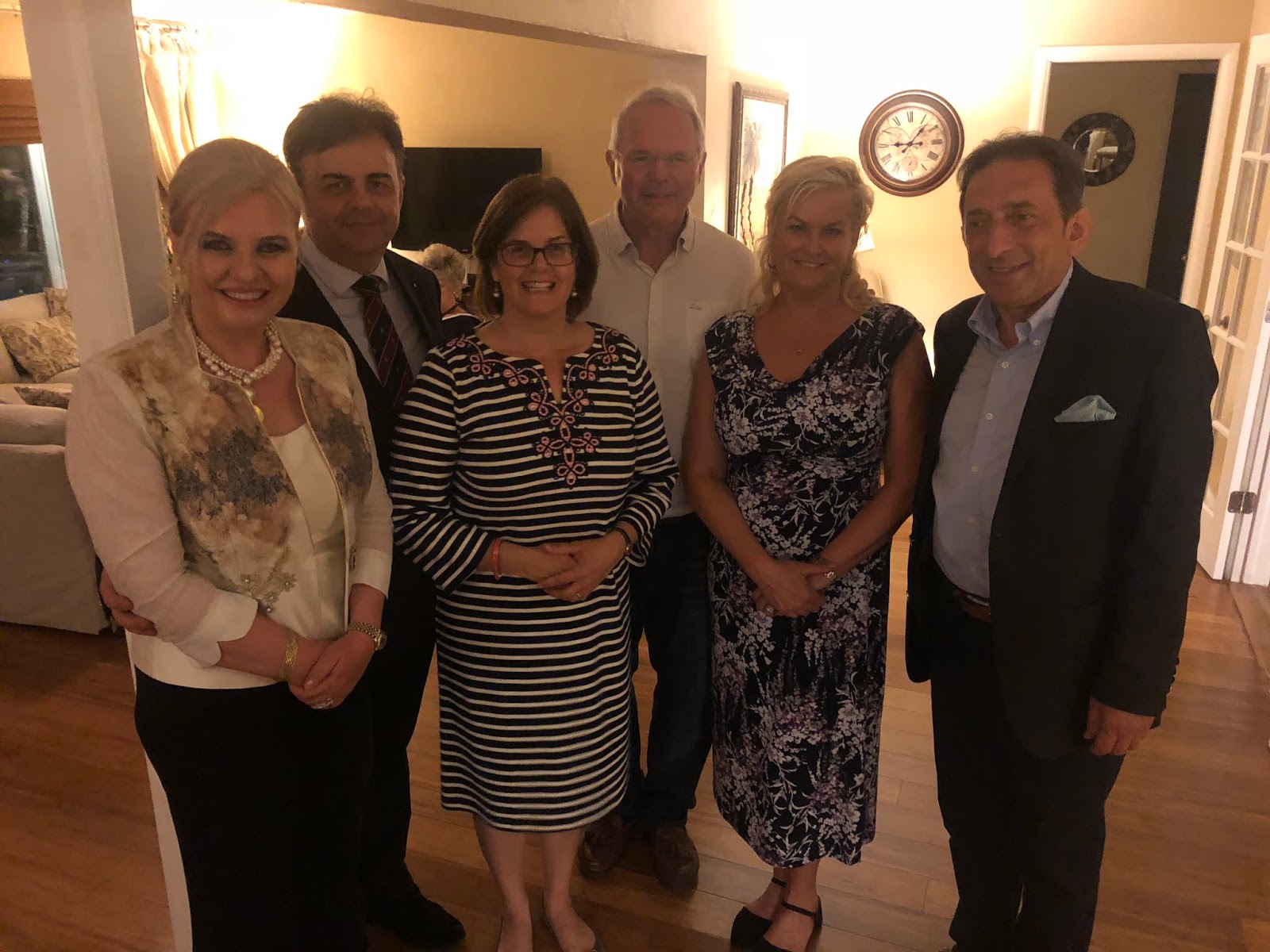
Here we are at a reception honoring their visit, hosted by Ambassador Christopher Hill and Mrs. Julie Hill.
You can see how happy we were to see Aneta
and Toni
the visit also coincided with Ambassador Prof. Dr. Reka's visit, who was in town for our signing the MOU with SEEU-USFSP ...here I was able to introduce him to our friend Judge Gross
Ambassador Hill and Ambassador Reka
how delighted we were to welcome our Macedonian friends to the Gulf Beaches!
Neighbours like
Slovenia attract the hiking hordes. It’s surely only a matter of time
till that changes, though: Macedonia’s credentials as a
lakes-and-mountains hotspot are exemplary"Credit:
ISTOCK
The underrated European country that's sure to improve your health
ickly cough? Runny nose? Broken sleep? For a fast and effective remedy, try Macedonia.
A visit to the pharmacy has never been more delightful. Clearly,
nobody loves scouring the aisles of plasters, paracetamol and
Preparation H in Boots. But on the wildflower-spangled slopes of Mount
Pelister in southern Macedonia, I found myself hiking through Europe’s
most alluring al-fresco apothecary store.
The meandering trail climbing
from the little village of Nizepole, you see, is lined with the delicate
pink blooms of lemon thyme, effective for alleviating insomnia. Mix
with cowslips, gleaming yolk-yellow among tufty alpine grass, for a tea
to soothe those sniffs and wheezes. Pluck a handful of plump,
indigo-black berries from shrubby dwarf junipers to settle a dodgy
tummy. And if your cough still niggles, try the time-tested local
treatment.
Pelister National ParkCredit:
ISTOCK
“Pick a few green Molika pine cones,” advised my softly spoken
mountain guide, Jonce Ilievski. “Snap them and layer with honey in a
glass jar. After 40 days you’ll have a soothing cough syrup.” And if the
herbs and berries don’t sort you out, the pristine air, soul-soaring
views and swathes of flowers – Pelister’s pink and lilac saffron,
knapweed and violet, bellflower and cyclamen – will soon have you
feeling in the pink.
I hadn’t come to Pelister National Park – first in the former
Yugoslavia, designated in 1948 to protect those endemic Molika pines –
for health reasons, of course. I was testing a new walking tour in the
craggy Republic of Macedonia, whose trails remain largely unsung while
erstwhile nation-mates such as Slovenia attract the hiking hordes. It’s
surely only a matter of time till that changes, though: Macedonia’s
credentials as a lakes-and-mountains hotspot are exemplary, and
augmented by fascinating historic relics befitting a major cultural
crossroads.
Berries and wild herbs aren’t the only tastes of note here, as I
learned on the drive from Skopje airport towards Pelister. Pausing for
lunch at Stobi Winery, the fruits of fine soils and 260 annual days of
sunshine emerged: Cab Sav, Merlot, Riesling and excellent oaked
Chardonnays, plus older regional varietals. There was Rkaciteli, an
ancient white from Georgia; Vraneč (‘black stallion’), a traditional
dark tipple; and strong red Kratošija, so long-established that – so
claimed local guru Gorki Balojani – “Alexander the Great drank it.”
Ah, The Alex Question. At school you were probably taught that the
serial conqueror was Greek – yet in the 4th century BC there was no
Greece per se. No, Alexander was Macedonian; the question is where
exactly ‘Macedonia’ was. Today’s Greeks insist it was on their patch,
demanding that their neighbour drops the moniker and sparking a
long-running spat with the former Yugoslav republic – a situation that
hit the headlines again this month with the signing of a cross-border deal that could see this nation renamed the Republic of North Macedonia and lift Greek objections to its membership of both EU and Nato.
What’s incontrovertible is the impact of Alexander’s dad, Philip, who
laid the foundations not only of the conqueror’s great empire but of a
metropolis now lying just north of the modern Greek border. The
archaeological site of Heraclea Lyncestis reflects Philip’s reputed
heritage – he claimed descent from Greek demigod Heracles, while his
mother Eurydice was of the Lyncestis tribe dwelling beneath Mount
Pelister. Divine ancestry or no, his legacy here is memorable: a
hotchpotch of Hellenic ruins, a magnificent Greek-cum-Roman arena (“The
acoustics are still amazing – ancient Dolby surround sound!”, quipped
Gorki) and gorgeous early Christian mosaics. At its peak Heraclea’s
population topped 20,000, before its destruction by earthquake in AD
518; today much awaits excavation. As Gorki wryly observed: “Macedonia
is one huge archaeological site – everywhere you dig, you uncover
fortresses, towns, tombs, marbles.”
After the quake, the populace resettled a mile or two north to what’s
now Bitola, Macedonia’s cosmopolitan second city and my first night’s
stop. Long an important staging post on the Via Egnatia, the major road
linking Thessaloniki with Rome, Bitola retains hints of its Ottoman pomp
around broad Širok Sokak (‘Wide Street’), still the see-and-be-seen
café culture artery. Though the influence of Islam is less dominant
today, it’s still evident what enchanted poet and painter Edward Lear on
his 1848 odyssey through the Balkans: “A more magnificently placed city
it is hardly possible to imagine, and the great quantity of cypress and
plane setting off its delicate white and pink mosque is wonderfully
beautiful… Interest and beauty in profusion, O ye artists!”
Lear didn’t relish his journey west across Pelister (“its monotonous
features were gloomy with dark and lowering clouds,” he griped), but he
missed a trick by not tackling the trails on foot. My climb up the
peak’s flanks was garnished not just with wildflowers and herbs but also
candy-sweet wild strawberries, butterflies like confetti, and ‘Pelister
Eyes’, a pair of alpine tarns alongside which we munched a mountain of
packed lunch. That afternoon was, if anything, more rewarding: tracing a
World-War-One French army track, we crossed a wild, bleakly beautiful
pass to descend towards glinting Prespa Lake. Startled by our approach, a
roe deer pronked out from a patch of white asphodels, and through a
dense oakwood we picked our way over muddy potholes grubbed up by wild
boar. Bear, lynx and wolves prowl these parts, too, though you’d be
lucky indeed to spot them.
That night we refuelled in the winsome village of Brajcino with a
rustic but delectable dinner comprising variations on
soon-to-become-familiar themes: flat ‘pie’ baked with flaky filo pastry,
red peppers stuffed and roasted into piquant ajvar relish, feta-like
sirenje cheese (a three-meals-a-day mainstay in Macedonia) and the local
moonshine, rakija – always rakija.
Next day we chugged across Prespa Lake to its largest isle, dozens of
white pelicans lifting off as we approached. Golem Grad (‘Big City’) is
a curious name for an island, especially one as compact and somnolent
as this; once, though, it was a hub of empire – summer retreat of one of
Macedonia’s other national heroes, Tsar Samoil, crowned king here in AD
997. Today it’s an atmospheric place to wander among the remains of
Byzantine churches and Samoil’s palace, watching for trundling
tortoises, water snakes and a cacophony of cormorants roosting in
guano-whitened boughs.
Heading west from Prespa, the road winds up and across Galičica
mountain to reach the viewpoint above Lake Ohrid where Lear rhapsodised:
“It is scarcely possible to dream of finer scenes than these… Bright,
broad and long lay the great sheet of water.” Hear hear, Ed.
The historic core of Ohrid, on the lake’s north-eastern shore, is
ringed by typically forgettable communist-era blocks. Yet like Heraclea
Lyncestis, it was both an important stop on the Via Egnatia and
developed by Philip of Macedon in the 4th century BC. The walls of Tsar
Samoil’s hilltop fortress still loom over the old town, which also
boasts a Roman amphitheatre and the site of reputedly Europe’s first
‘university’, a monastic school founded in AD 893 by St Kliment,
co-creator of the Cyrillic alphabet. Amid fresco-daubed Byzantine
churches and stone-built merchants’ houses, cobbled alleys are lined
with appealing restaurants dishing up tasty Ohrid fish: “The trout of
the Lake of Akhridha are surpassingly fine,” burped Lear.
Gorki and Jonce had saved the toughest hiking challenge till last: an
attempt on Mount Korab, at 2,764m the highest peak in both Macedonia
and Albania, its summit shared between both. The drive to the trailhead
in Mavrovo National Park is an adventure in itself, negotiating a
succession of increasingly dramatic and claustrophobic gorges and
climaxing with the rough track that snakes along the Radika valley to
the border post at Strezimir. Our packs weighed down with chicken,
salad, bread and – naturally – sirenje cheese, we ascended through
magical silver birch forest ringing with the song of a gushing burn.
Soon we emerged onto steep meadows where a volley of barks and growls
alerted us to a nearby posse of baying hounds, recalling Lear’s fretful
observation that “large herds of goats browsingly wandered among the
stunted herbage under the guarding care of ferocious dogs”.
A word from Jonce to the dogs’ master soon gained us a pass up to wilder
upper reaches where the lilac hues of saffron and violets echoed
purple-veined marble slabs on the path. Above a broad saddle where
horses grazed as their Albanian owners gathered camomile, we crested a
ridge to be rewarded with the panoramic prize: vistas of a fanged ridge
spanning the entire western horizon, bookended by the craggy, leaning
slab of Korab. Here our way was blocked by steep snow tongues, their
crust of avalanche detritus warning us of the foolhardiness of a
traverse so early in June. No matter: the panorama was sensational
enough to sate my taste for high drama.
How to visit Macedonia
Paul Bloomfield was a guest of Walks Worldwide (01962 302085; walksworldwide.com)
on its new Trails of Macedonia itinerary. The guided small-group trek
costs from £1,399, including seven nights’ full-board accommodation and
local transport but not flights. Departs September 15 and October 6
2018. WizzAir (wizzair.com) flies London Luton-Skopje from £22.99 each way.
I was delighted to attend the World PartnershipsSeasons of Diplomacy dinner in St. Petersburg back in April. This was a part of their hosting 80 leaders from 58 countries on behalf of a US Department of State Special Initiative: Towards a More Safe and Secure World.
In addition to supporting World Partnerships, I was there to meet a judge from Macedonia -- Judge Krstikjeska of the Primary Court in Skopje. We had an engaging conversation over dinner. I am looking forward to visiting her at the courthouse on my next trip to Skopje.
It was a pleasure to meet Charlotte Titus, the Chief of the Europe and Eurasia Branch of the Office of International Visitors, who spoke at the dinner as well.
During the welcome reception before the dinner, we heard a presentation from one of the founders of the American Freedom Distillery and its Horse Soldier Bourbon. Wow! These are the famous soldiers who responded to the call after 9/11. If you don't already know their story, click on the link below to learn more.
at the registration -- with Gary Springer, of World Partnerships, along with Judge Krstikjeska and a police officer from Scotland
with Mary Ellen Upton of World Partnerships
the Chief of the Europe and Eurasia Branch of the Office of International Visitors, Charlotte Titus
I appreciate all that Gary and Mary Ellen do at World Partnerships to bring international visitors to St Pete (photo of one of the centerpieces)
with one of the founders of the American Freedom Distillery -- wonderful to hear about the Horse Soldiers -- and about the bourbon. If you don't already know their amazing story - please check out the link above - as well as the trailer to the movie about them and their mission, 12 Strong. I very much enjoyed the bourbon. Need to go buy a bottle of the Horse Soldier!
the molds for the bottles are made from steel from the World Trade Center
It was a pleasure to have the opportunity to meet with Macedonian journalist Arta Tahiri when she was visiting St. Petersburg as a part of the distinguished Edward R. Murrow program.
Thanks to Gary andMary Ellen and World Partnerships for connecting us when hosting this IVLP - International Visitor Leadership Program
I participated in this meeting via Skype videoconference, as I was in
California participating in the Civic Learning and Democratic
Engagement CLDE 2018 conference. (I organized a Think Tank session with
my colleague Prof. Elizabeth Bennion about "Civic Engagement in the
Online Classroom.") For me, the meetings took place between Midnight and 4:00 AM, and my next meeting at the conference started at 7:30 AM. So it made for a long night. However, I wanted very much to participate in this first Board meeting as well as the election of the new Rector, so I was most grateful for the Secretary-General and the IT Department in working hard to ensure the smooth connection and my participation in the meetings.
I appreciated this accommodation due to my professional obligations at the conference. but I am looking forward to participating in the November meeting in person.
USF St. Petersburg Signs First American University Collaboration Agreement with South East European University
Interim
Regional Chancellor Martin Tadlock (left) and Professor Blerim Reka
from South East European University sign the collaboration agreement.
(May 25, 2018) – At a signing ceremony last month,
USF St. Petersburg became the first American higher education
institution to form a collaboration agreement with South East European
University in Macedonia. The agreement signed on April 24, 2018 promotes
joint educational and research activities between the two universities,
such as allowing for the exchange of visiting scholars to participate
on joint projects.
It also begins discussions for developing a future undergraduate and
graduate exchange program that would offer students from both
universities the opportunity to study in a different country and
experience that nation’s culture.
“We are excited for the research opportunities this agreement will
give our students and faculty and is just another example of developing
new ways for our community to engage globally,” said Interim Regional
Chancellor Martin Tadlock during the signing event.
South East European University is the first and only private-public
not for profit university in Macedonia, established in 2001. It focuses
on five concentrations, which are Contemporary Sciences and
Technologies; Languages, Cultures and Communication; Law; Public
Administration and Political Science; and Business and Economics.
“In 15 years we have become the second largest university in the
country, with almost 6,000 students,” said Blerim Reka, Professor of
International Relations and Law at SEEU and a former Ambassador.
Reka, who has written two dozen books, is an expert on the Balkans
and involved in the development of constitutional frameworks for
Macedonia and Kosova, came all the way from Skopje, Macedonia for the
signing. While here, he also gave a talk for the USFSP community on the
“Geopolitics of the Balkans: Between the West and Russia.” The talk
detailed the recent geopolitical events and issues impacting the
Balkans, influenced greatly by energy demands, culture, history and the
competing forces of the European Union and Russia.
USFSP
Political Science Professor Judithanne Scourfield McLauchlan, Reka,
Tadlock and College of Arts and Sciences Dean Frank Biafora pose after
the signing event.
The collaboration agreement was initiated by USFSP Political Science
Professor Judithanne Scourfield McLauchlan, who was a Fulbright scholar
in Macedonia during the Spring 2017 semester. McLauchlan taught
constitutional law and civics courses at South East European University
and at the University of Tetovo. Her time in the country – and a
previous Fulbright scholarship to Moldova – form the basis for her
current research on how civil society can strengthen rule of law
efforts.
“At our Undergraduate Research Symposium this year, students from
SEEU joined our students via Skype to present research posters comparing
and contrasting decisions by the U.S. Supreme Court and the European
Court of Human Rights on different civil liberties issues,” said
McLauchlan. “This is just the kind of research collaboration that we
hope to foster even more with this agreement.”




 A word from Jonce to the dogs’ master soon gained us a pass up to wilder
upper reaches where the lilac hues of saffron and violets echoed
purple-veined marble slabs on the path. Above a broad saddle where
horses grazed as their Albanian owners gathered camomile, we crested a
ridge to be rewarded with the panoramic prize: vistas of a fanged ridge
spanning the entire western horizon, bookended by the craggy, leaning
slab of Korab. Here our way was blocked by steep snow tongues, their
crust of avalanche detritus warning us of the foolhardiness of a
traverse so early in June. No matter: the panorama was sensational
enough to sate my taste for high drama.


